6:45 PM Saturday, September 28, 2024
Today, Duluth experienced a record high temperature for the third consecutive day.
–Duluth, MN: The temperature reached 82 degrees, surpassing the previous record high for September 28th, which was 81 degrees set in 2014.
–Hibbing, MN: The temperature reached 84 degrees, surpassing the previous record high for September 28th of 82 degrees, which was set in 2014.
Note: Duluth has experienced nine days this month with highs of at least 80 degrees. The record for the most days with a high of at least 80 degrees is ten, set in September 1908.
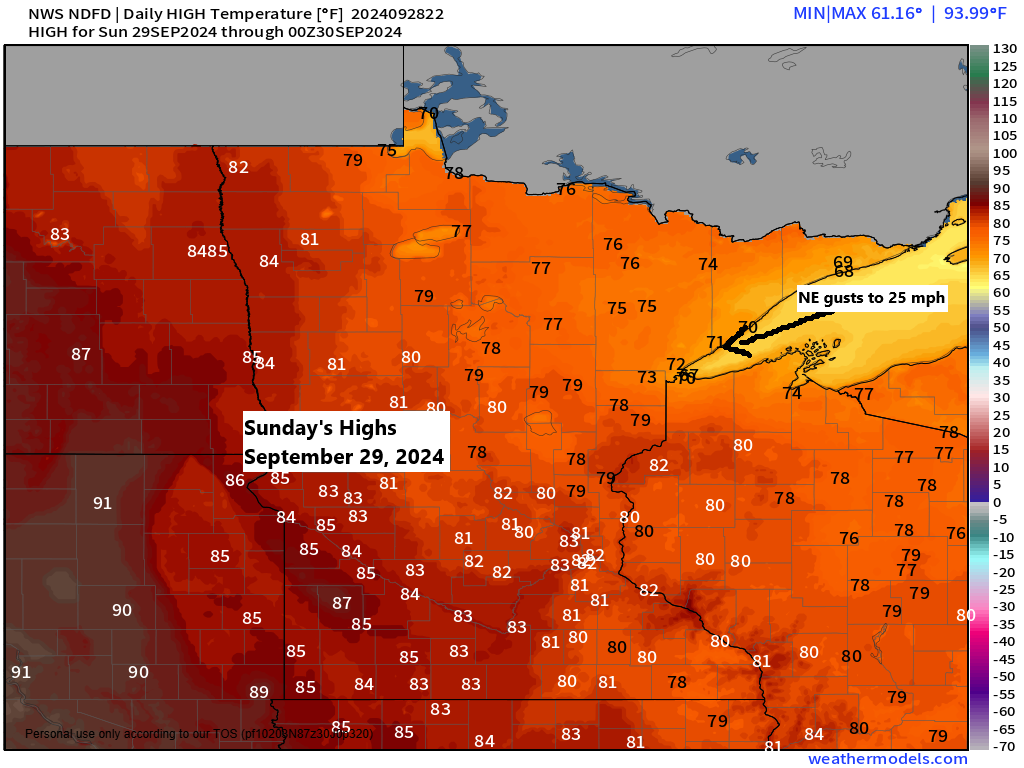
Duluth is not anticipated to experience record warmth on Sunday due to a robust northeast wind emanating from Lake Superior. Temperatures are forecasted to reach the 60s within approximately 10-15 miles of Lake Superior, while areas further inland may see highs in the 70s or approaching 80 degrees.
Next week, the Northland will experience several cold fronts. One is expected Monday afternoon/evening, another Wednesday night, and a subsequent one sometime next weekend. These fronts will reduce the 500mb heights in our region and bring cooler, more typical seasonal temperatures. However, there will be occasional temperature spikes ahead of these fronts, with one on Monday likely to push highs into the 70s and lower 80s in our area.
Unfortunately, there are no signs of widespread rain in our area, even with the fronts moving across next week. However, the possibility of a few scattered showers cannot be dismissed entirely, although widespread rainfall does not seem likely at the moment.
The Northland is currently positioned in an upper-level ridge, exhibiting high 500mb heights of approximately 587 decameters today. A change in this pattern is expected next week, starting with Monday’s cold front, as 500mb heights are forecasted to decrease to around 558 decameters by Tuesday morning, aligning more closely with the seasonal norm.
Temperature patterns are influenced by the positioning of upper-level lows, or troughs, and ridges. Cooler temperatures are typically found near the troughs, while significantly warmer temperatures occur near the ridges.

Minimal to no rainfall is anticipated in the Northland region until at least next Saturday morning.

Thanks for reading!
Leave a Reply