The main focus moving forward is the persistent drought affecting much of the Northland, particularly northwest Wisconsin, east-central Minnesota, and the Twin Ports region extending west to the Brainerd Lakes.
All of northeast Minnesota and much of northwest Wisconsin is experiencing severe drought, classified as level 2, while some areas of northwest Wisconsin are facing extreme drought, or level 3, indicated in red on the map.

Here’s a closer look at how drought conditions in the Northland evolved from mid-July to mid-August.
July 14, 2026

August 18, 2026

Soil moisture in parts of far northern Minnesota is near or above normal (shown in blue on the map) due to recent rains over the past month, while much of the rest of the Northland is experiencing well below-average soil moisture, particularly in the red-shaded areas, where levels range from 0 to just 5%.

August 2026 precipitation rankings by climate district indicate that northwest Wisconsin is experiencing its second driest August on record (dark brown area on the map), while regions from Illinois through Indiana, Ohio, West Virginia, and western Pennsylvania are seeing one of their wettest Augusts, often ranking in the top five.

During the past month, rainfall has been 2 to 4 inches below average across northwest Wisconsin, east central Minnesota, the Twin Ports, and sections of the North Shore, while far northern Minnesota has seen totals 1 to 2 inches above normal or more.

Percentage of normal precipitation from July 23 to August 22, 2026.

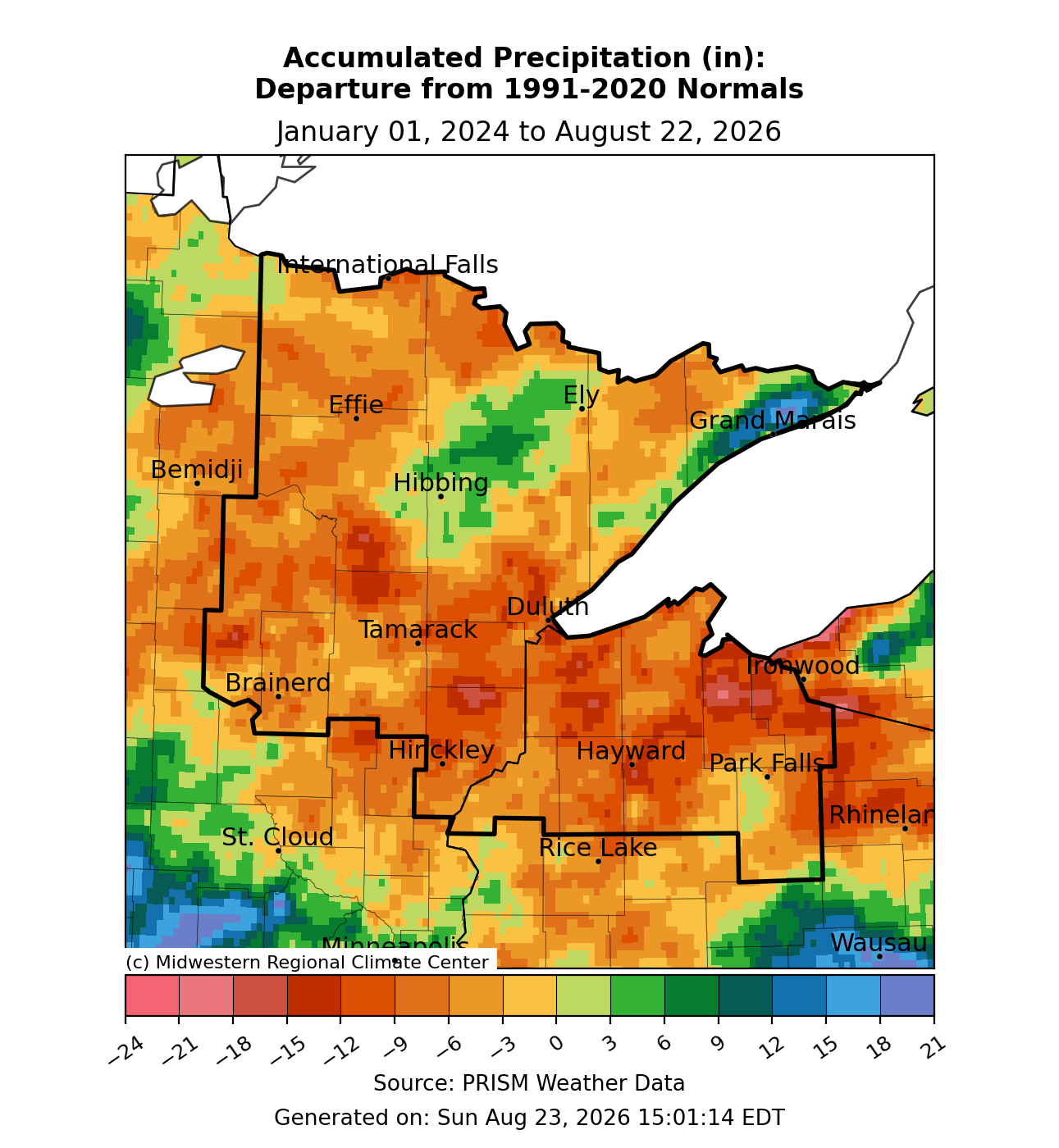
The main concern is the persistent drought affecting much of the Northland since 2024.
Unfortunately, Duluth has faced a substantial precipitation deficit, recording 16.43 inches below the normal level since January 1, 2024, which is likely impacting local gardens, landscapes, and water resources.
If you look back to 2010, Duluth experienced several notably dry years, including 2025 with just 20.34 inches of precipitation and 2020 with 21.26 inches, while the wettest year since 2010 was 2017, recording 36.78 inches of precipitation.
Duluth last recorded above-average precipitation in 2023, finishing 1.81 inches above the seasonal average.

Leave a Reply