This week, I’ll review past strong El Niño events and analyze the winter conditions they produced in Duluth and across the Northland.
The three winters I’m highlighting—1982-83, 1997-98, and 2015-16—were all strong El Niño events, much like the one we are experiencing now.
With a strong El Niño already established and expected to persist through the 2026–2027 winter, here’s an overview of the typical El Niño pattern during the season.
Observed phenomena include above-average sea surface temperatures in the central and eastern equatorial Pacific, weakened or reversed trade winds, an eastward displacement of the Pacific jet stream, increased precipitation across the southern United States, and warmer, drier conditions in the northern United States.

Today’s post will focus on the winter of 1982–83.
Summary — The winter of 1982-83 in Duluth was slightly warmer than average, with snowfall approximately 4.5 inches below the December through February norm. However, the total seasonal snowfall reached 96.5 inches, 6.3 inches above the long-term average. The season’s first measurable snowfall of 0.1 inch occurred on October 17 (0.7 inches), while the first accumulation of 1 inch or more fell on November 3. The last snowfall of 1 inch or more occurred on April 14, which also marked the season’s highest single-day snowfall at 11.6 inches.
Snowfall Data for Duluth, Minnesota
December 1982
Total: 21.4″
Normal: 18.7″
Departure: +2.7″
January 1983
Total: 15.7″
Normal: 16.8″
Departure: -1.1″
February 1983
Total: 9.0″
Normal: 15.1″
Departure: -6.1″
The highest recorded single-day snowfall during the winter season was 6.9 inches, occurring on December 25, 1982.
The average snowfall in Duluth from December through February is 50.6 inches.
Total snowfall: 46.1″
Departure: -4.5″
Note: For the 1982-83 snow season, which generally extends from October through April and occasionally into May, Duluth recorded a total snowfall of 96.5 inches. Notably, April 1983 experienced 23.7 inches of snow, while November 1982 contributed a substantial 16.0 inches.
Winter 1982–1983 Temperature Overview for Duluth, Minnesota
Average: 17.9 degrees
Normal: 14.6 degrees
Departure: +3.3 degrees
Number of subzero nights: 22
Normal: 35
Departure: -13
Month-by-month breakdown of subzero nights
December 1982: 7
Normal: 9
Departure: -2
January 1983: 8
Normal: 15
Departure: -7
February 1983: 7
Normal: 11
Departure: -4
The lowest temperature recorded in Duluth during the 1982–1983 winter season was -23°F on January 18.
Additional information for the winter of 1982–83
The following map illustrates temperature anomalies in the Northland region for the winter of 1982–83, encompassing the months of December, January, and February.
The entire Northland experienced temperatures roughly 3 to 6 degrees above the seasonal average.

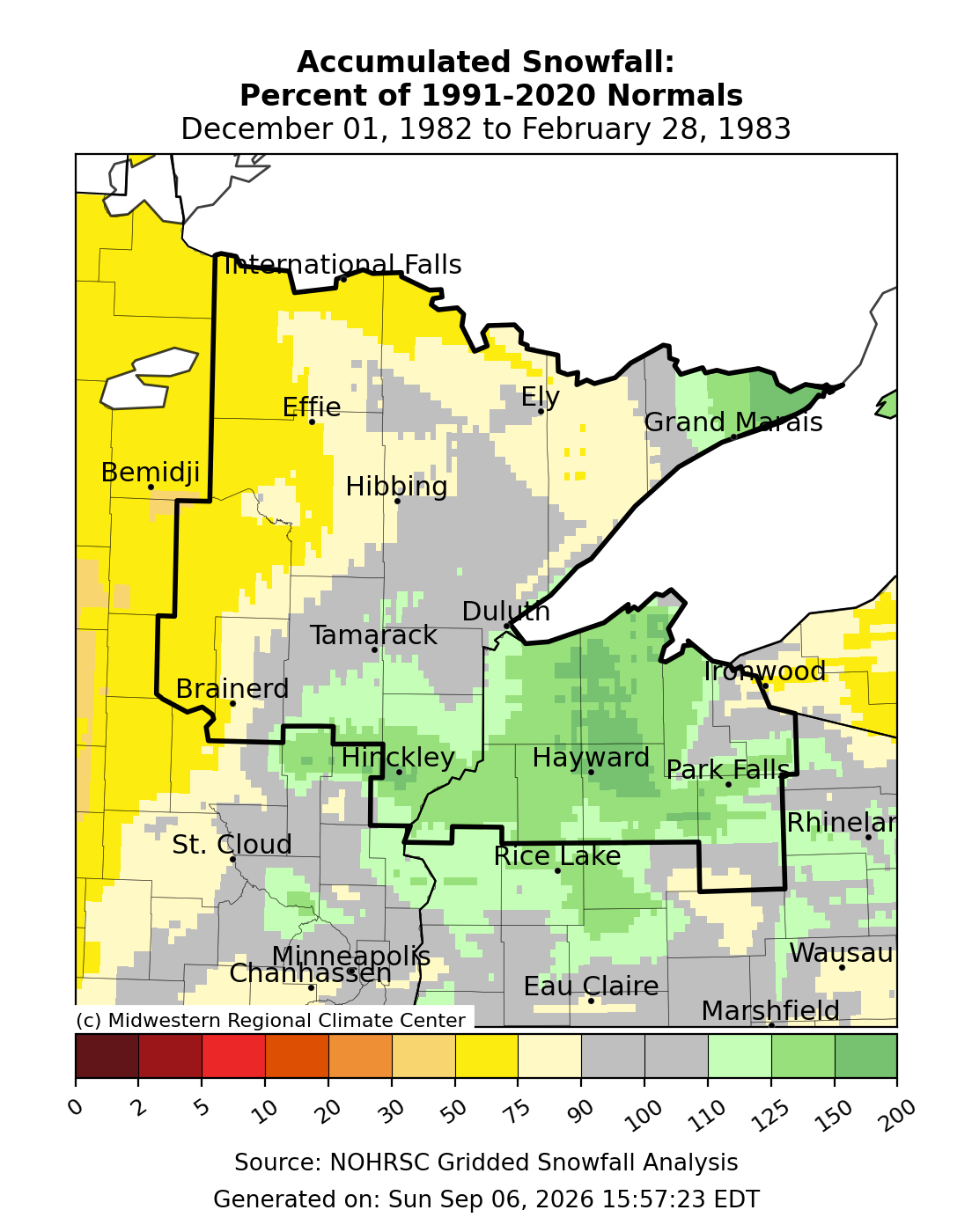
Snowfall across the Northland during the 1982-83 winter season (December through February) was above average in the green-shaded areas, near normal in the gray-shaded areas, and below average in the yellow-shaded areas.

Looking at the U.S. as a whole, the winter of 1982-83 exhibited a typical El Niño temperature pattern, with below-average temperatures (shown in blue) across the southern U.S. and above-average temperatures in the northern U.S.

U.S. snowfall anomaly for the winter of 1982-83, with green and blue areas indicating above-average snowfall, and yellow, orange, and red areas showing below-average snowfall.

Leave a Reply