5:33 PM Wednesday, December 28, 2022
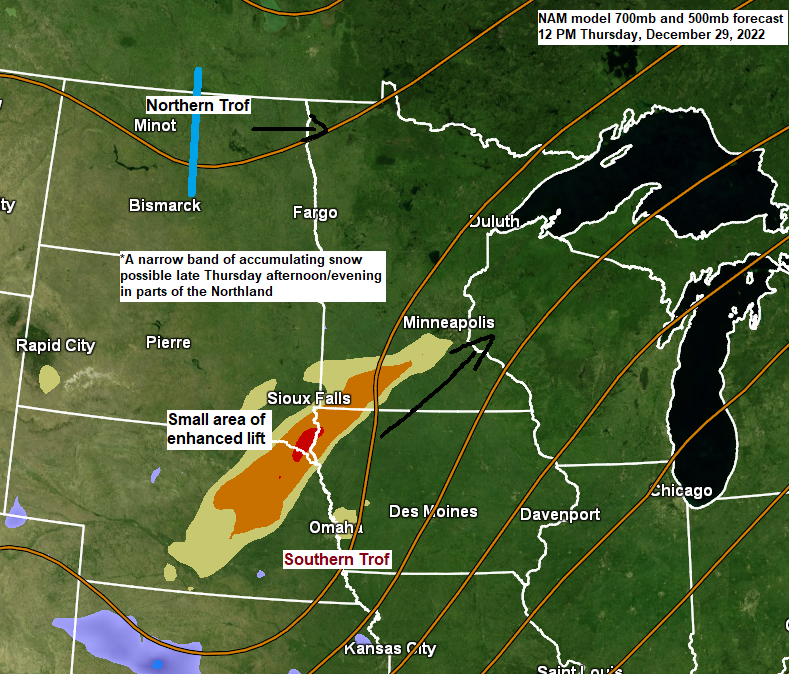
A bit of a complex setup ahead for Thursday as will see some energy approach from Manitoba and North Dakota, while a somewhat stronger wave lifts northeast out of the central Plains. The ball of energy moving out of the central Plains is forecast to have a small area of enhanced lift which could produce an area of moderate snowfall for a short period of time, but since this area of heavier snow looks relatively small, the computer models are having trouble figuring out where this pocket of snow will setup. The good news in all this is that snow totals look fairly minor due to the progressive nature of this whole system, with snow totals maxing out at around 2 inches under the corridor of heavier snow.
Here’s the 21z RAP model 700mb forecast valid 12 PM Thursday to Midnight Thursday night. Stronger vertical lift shows up in green, yellow and orange on the animation below.

Here’s my snowfall forecast for late Thursday afternoon through late Thursday evening.
For Duluth — Snowfall totals of a trace to 2 inches are possible.

There is a chance for some patchy fog, drizzle and freezing drizzle across the Northland tonight into Thursday, and then we could see some steadier precipitation which should transition to mostly snow affect parts of northeast and east-central Minnesota and northwest Wisconsin late Thursday afternoon through Thursday evening.
For Duluth — Timing for when we could see a steadier period of snow which may start out as a mix is from around 3 PM to Midnight Thursday.
12z NAM 3km model radar forecast valid 12 PM Thursday to 6 AM Friday.
Snow (blue)
Wintry Mix (pink)

The current pattern is loaded with storm after storm crashing into the western U.S.
Goes-16 water vapor loop from Wednesday, December 28, 2022 (loop time ends 4:50 PM CT)

STORM THREAT NEXT WEEK
Computer models are in good agreement in showing a strong 500mb trough digging into the Southern/Central Rockies late this weekend with the 12z GFS model from Wednesday showing this trough at around -4.0 sigma.

Considerable uncertainty does exist however in regard to the storm track, but this isn’t unusual for a system which is roughly 5 days out.
Euro model guidance remains much farther south with the storm track for next week while the GFS and Canadian models are farther to the north.
A farther south storm track would lead to snow being the main precipitation type with the highest accumulations from south-central Minnesota into northern Wisconsin with lower snow amounts for northern Minnesota.
A storm track farther to the north would lead to a mix bag of precipitation types ranging from snow to rain, and possibly even some sleet or freezing rain, with the highest snow amounts with a farther north storm track likely setting from western to north-central Minnesota.
Either scenario is plausible at this point.
Stay tuned.

EPS model probability for more than 6 inches of snow for early to mid-next week.
Note — The 50-member 12z EPS model from Wednesday for Duluth shows 6/50 members (12%) with 10″ or more of snow, while 21/50 (42%) members show 6″ or more of snow in Duluth during the early to mid-next week time frame.

A recap of the 2022 severe weather season.
Minnesota
1089 severe weather reports in 2022
Tornadoes — 77 (average number of tornadoes 42 — 1995-2014 climate period)
Damaging Wind (58 mph or greater) 625
Large hail (1 inch or greater in diameter) 387
The 2022 severe weather season in Minnesota began in April with 61 reports of severe weather including 4 tornado reports, but the severe weather season peaked the following month in May of 2022 with a total of 568 reports of severe weather including 51 tornado reports.
The 2022 severe weather season saw fewer severe weather reports during the summer months, with 235 severe weather reports (9 tornadoes) in June, followed by 128 reports of severe weather (6 tornadoes) in July, with August featuring even fewer severe weather reports with a total of 66 (5 tornadoes)
Map legend
Tornado reports (red)
Hail reports (green)
Wind reports (blue)

Wisconsin
466 severe weather reports in 2022.
Tornadoes — 34 (average number of tornadoes 23 — 1995-2014 climate period)
Damaging Wind (58 mph or greater) 309
Large Hail (1″ or greater in diameter) 123
Map legend
Tornadoes (red)
Hail (green)
Wind (blue)

Duluth, Minnesota recorded 44 thunderstorm days in 2022 which is above the average of 30 to 40 thunderstorm days per year.

Thanks for reading!
Tim
Leave a Reply